
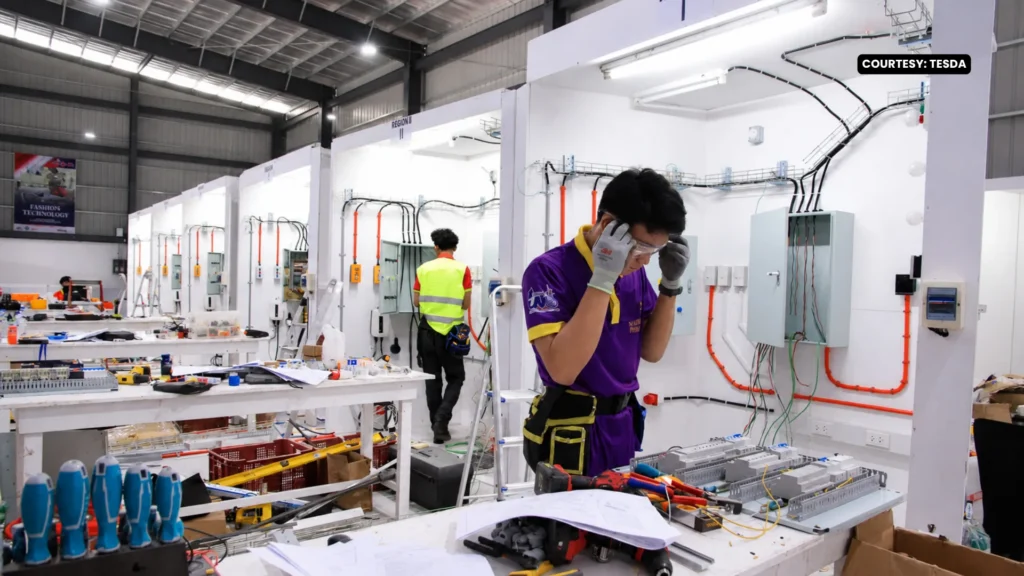
Senator Joel Villanueva is pressing the Technical Education and Skills Development Authority (TESDA) to pivot toward advanced technical-vocational training, arguing that reliance on basic credentials leaves Filipino workers stuck in low-paying jobs.
During recent agency budget deliberations, TESDA revealed that out of 1.45 million graduates, barely one percent reached a National Certificate (NC) Level 5 or higher diploma-level program. Further data presented by the Second Congressional Commission on Education (EDCOM 2), where Villanueva serves as co-chairperson, showed that 93 percent of graduates completed only basic NC I and NC II training.
Though TESDA maintains an 81 percent employment placement rate for its alumni, a significant number continue to earn below the regional minimum wage. In contrast, statistics indicate that graduates of NC IV and NC V programs command noticeably higher earnings and better career progression.
“We cannot keep training workers only for entry-level jobs when industries increasingly demand advanced technical skills, specialization, and supervisory capabilities,” said Villanueva, who previously headed TESDA as its director general. “If we want our Filipino workers to level up, TESDA must move up with them.”
Findings from EDCOM 2 highlight systemic bottlenecks within the Philippine technical-vocational education and training (TVET) landscape, including outdated Training Regulations, inconsistent competency materials, and persistent shortages of qualified instructors in high-demand fields. Research by the commission also identified a disconnect between TVET courses and evolving industry standards, limited recognition of credentials, and sparse private sector involvement in curriculum assessment and certification.
Villanueva urged TESDA to use the EDCOM 2 findings to overhaul its operational targets, urging the agency to prioritize advanced programs aligned with modern industrial demands.
“The question should no longer be simply, ‘How many did we train?’ We should be asking: How many became certified? How many moved to higher qualifications? How many obtained jobs that match their skills? And how many saw their incomes improve?” Villanueva said.
“Employment alone is not the finish line,” the lawmaker emphasized. “If a graduate is employed but remains trapped in low-paying work, then we have to ask whether the training is really giving that worker a pathway to better opportunities and better lives.”